
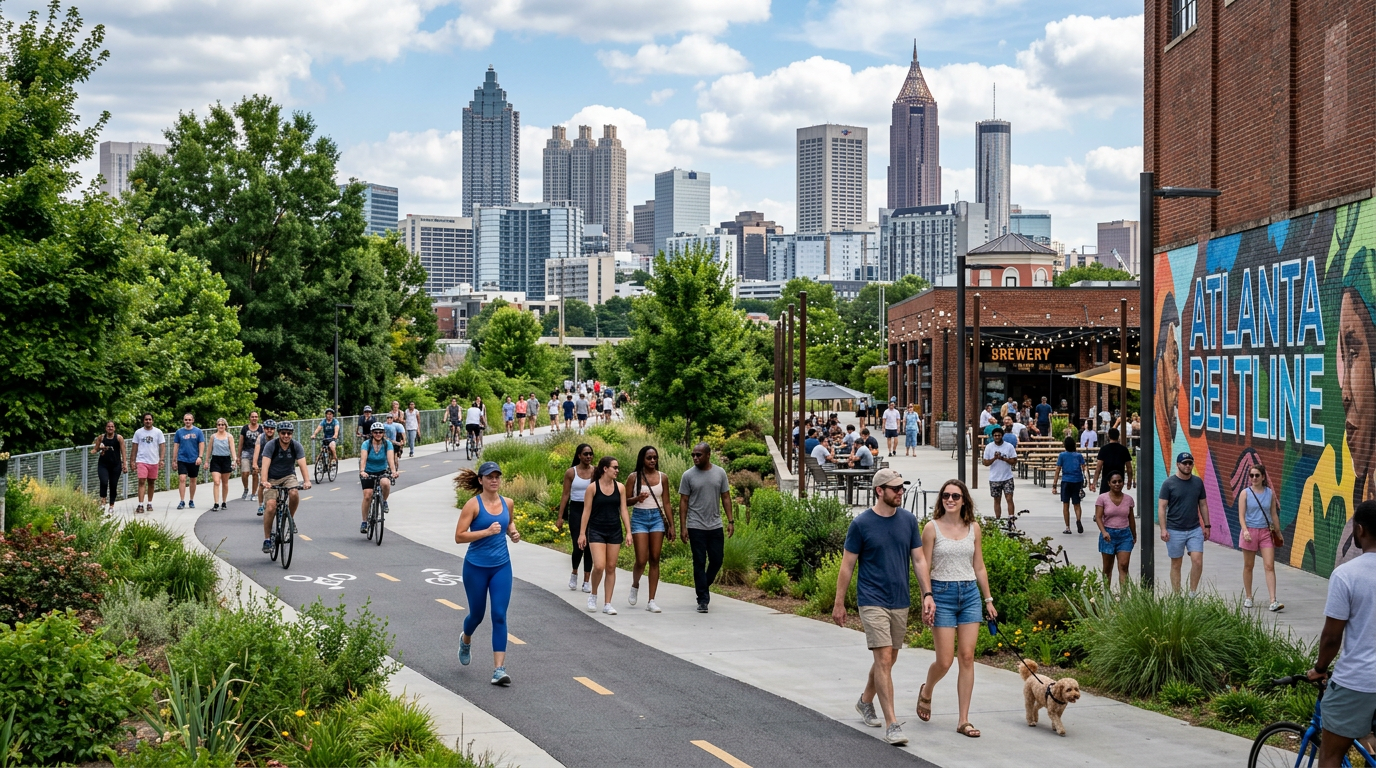
The Atlanta BeltLine has become one of the city’s biggest success stories.
What started as a bold idea to reconnect neighborhoods through trails, transit, parks, and redevelopment has turned into one of Atlanta’s most visible engines for growth. Walk the BeltLine on a busy weekend and you can feel it. Restaurants are packed. Coffee shops are full. Apartment buildings are rising. Tourists are taking pictures. Runners, cyclists, families, and entrepreneurs are all moving through the same corridor.
The BeltLine is no longer just a trail.
It is an economic force.
According to Atlanta BeltLine, activity within the BeltLine Planning Area supported more than 91,000 jobs and generated an estimated $23 billion in annual economic output in 2025. The project has also helped attract $14.2 billion in private investment since its beginning, passing its original $10 billion goal ahead of schedule.
That is the kind of growth cities dream about.
But for small businesses, growth is complicated.
More foot traffic can mean more customers. More visitors can mean more sales. More development can make a neighborhood feel alive. But the same energy that makes an area attractive can also make it expensive. As the BeltLine becomes more popular, commercial rents rise, new developments move in, and local businesses may find themselves fighting to stay in the very neighborhoods they helped make valuable.
That is the pressure point.
Atlanta wants the BeltLine to be a place where local businesses thrive, not just a place where national brands can afford the rent. The challenge is making sure small businesses are not only used as decoration for “authentic neighborhood culture,” but actually protected, supported, and positioned to grow.
The BeltLine has already acknowledged that commercial affordability matters. Its small business support efforts include the Atlanta BeltLine Marketplace, a small business incubator offering affordable commercial spaces directly along the corridor. The organization also describes commercial affordability as a long-term focus, with multiple initiatives designed to preserve or create affordable space for small businesses.
That support is important because access to customers does not mean much if a business cannot afford to stay open.
A local coffee shop may benefit from more walkers on the trail, but if the rent doubles, the math changes. A boutique may get more visibility, but if a larger retailer moves nearby with a bigger marketing budget, competition changes. A food vendor may gain attention from events, but still need permits, staffing, inventory, and digital systems to turn attention into real revenue.
Growth creates opportunity, but it also exposes who is prepared.
That is especially true with the 2026 FIFA World Cup approaching. The BeltLine has introduced a small business readiness plan connected to World Cup opportunities, including a toolkit, digital hub, and trail-wide programming to help local businesses prepare for visitors and events across Atlanta neighborhoods.
This is where the BeltLine story becomes bigger than real estate.
It becomes a test of whether Atlanta can grow without erasing itself.
The businesses that give Atlanta its flavor are often small, local, Black-owned, family-run, immigrant-owned, creative, or neighborhood-rooted. They are not always the businesses with the biggest budgets. But they are the ones that make people say, “This feels like Atlanta.”
If those businesses get pushed out, the city loses more than storefronts. It loses identity.
The good news is that there are efforts to address the issue. Atlanta BeltLine has launched programs like BeltLine Business Ventures, a small business accelerator designed to provide technical assistance and resources to help local businesses scale and locate within the BeltLine Planning Area.
There has also been a Local Developer Incentive Fund, offering recoverable grants from $150,000 to $500,000 to developers who create below-market commercial spaces in the BeltLine corridor. The goal is to support developments that dedicate some commercial space to affordable rents for small businesses.
That is the kind of strategy Atlanta needs more of.
Because the future of the BeltLine cannot only be measured by cranes, condos, and private investment. It also has to be measured by who gets to stay, who gets to build, and who gets to benefit.
Small businesses should also take ownership of their side of the opportunity.
They need stronger branding. Better websites. Clearer offers. Updated Google Business profiles. Email lists. Social media content. Event partnerships. Customer retention systems. Merch. Pop-ups. Collaborations. World Cup promotions. Neighborhood storytelling.
The BeltLine can bring people past the door.
But businesses still have to give people a reason to walk in, buy, return, and remember them.
This is the moment for Atlanta’s small business owners to stop treating the BeltLine as just a busy area and start treating it like a media channel, a tourism corridor, and a customer acquisition engine.
The attention is already there.
The question is whether local businesses will be able to afford it, own it, and convert it into long-term growth.
Atlanta’s BeltLine is growing fast.
Now the city has to decide whether that growth will create more local opportunity, or simply make room for those who can pay the most.
 Verified ATL