
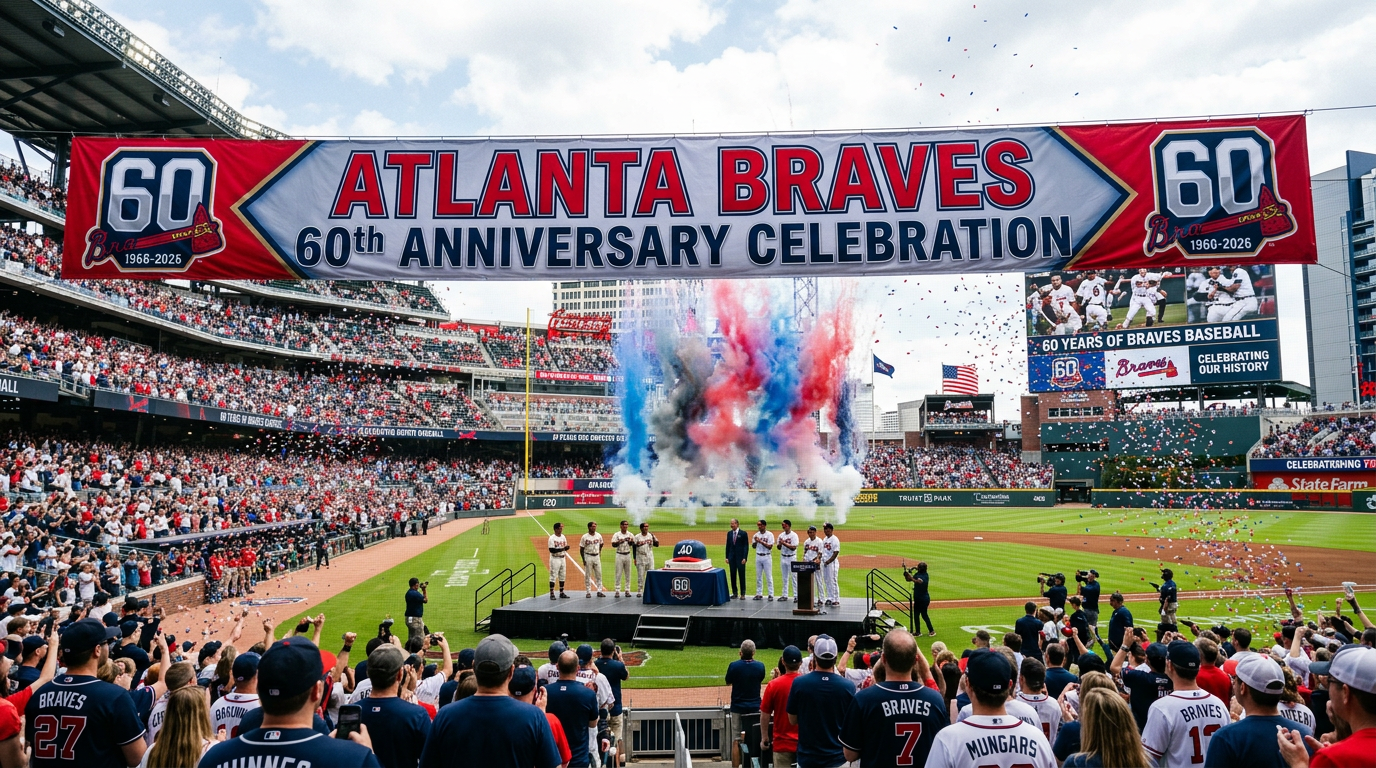
The Atlanta Braves are not just playing another season.
They are celebrating 60 years of Braves baseball in Atlanta, a milestone that turns this season into something bigger than standings, injuries, and box scores. It is a chance to look at how one franchise became part of the city’s identity, part of the region’s economy, and part of the way generations of people in Georgia connect to sports.
The Braves opened their 2026 home schedule with a 60th anniversary celebration at Truist Park, marking six decades since the franchise arrived in Atlanta. Fans gathered for the home opener against the Kansas City Royals, with the team leaning into the anniversary through special events, ballpark upgrades, and new experiences throughout the season.
That history matters.
For a lot of Atlanta families, the Braves are not just a team you watch. They are a memory passed down. They are summer nights, radio broadcasts, Chipper Jones jerseys, Hank Aaron stories, playoff heartbreaks, World Series pride, and family trips to the ballpark.
The Braves have become one of the rare Atlanta institutions that connects different generations at the same time. Grandparents remember Atlanta-Fulton County Stadium. Parents remember Turner Field. Younger fans are growing up with Truist Park and The Battery.
That evolution tells a larger story about Atlanta itself.
The Braves moved from the heart of the city to Cobb County, and Truist Park eventually became more than a stadium. It became the center of a mixed-use sports district. The Battery Atlanta now includes restaurants, retail, apartments, offices, hotels, and entertainment built around the game-day experience.
Cobb County says the taxable value of property in The Battery area grew from $5 million in 2014 to $577 million in 2024, spanning 56 parcels. According to the county, that growth has produced millions in revenue for local government, schools, the state, and the Cumberland CID.
That is why the Braves story is not just about baseball anymore.
It is about how sports franchises are becoming real estate engines, tourism drivers, entertainment brands, and cultural anchors. A Braves game is no longer only a three-hour event. For many fans, it is dinner before first pitch, drinks after the final out, photos outside the stadium, live music, shopping, and a full night at The Battery.
That is good business. But it also raises a fair question for Atlanta.
When a team becomes this big, who benefits?
The Braves and The Battery have clearly created a model other cities are watching. But the conversation around stadium development is never simple. Critics have questioned whether mixed-use districts fully justify public investment, especially when taxpayers help fund major sports projects. One 2026 analysis argued that The Battery has not fully reversed the broader economics of stadium subsidies, even with its surrounding development.
That tension makes the Braves a perfect Atlanta story.
On one side, you have a beloved franchise celebrating 60 years in the city. On the other, you have a modern sports business that shows how much professional teams have changed. The Braves are no longer just selling tickets. They are selling an experience, a neighborhood, a lifestyle, and a year-round destination.
This season also comes with pressure on the field.
The Braves entered 2026 trying to bounce back from a disappointing 2025 season, and injuries have already been part of the storyline. MLB’s injury tracker listed several Braves players dealing with injuries early in the season, including AJ Smith-Shawver, Hurston Waldrep, Spencer Strider, and others.
But that may be what makes this anniversary season even more interesting.
The Braves are celebrating the past while trying to prove something in the present.
That is what Atlanta understands well. The city is always balancing legacy and reinvention. Old Atlanta and new Atlanta. Tradition and growth. Neighborhood identity and commercial development. The Braves sit right in the middle of that tension.
For 60 years, the team has given Atlanta something to rally around.
Now, the Braves are showing what the future of sports in metro Atlanta looks like: part team, part entertainment district, part economic development project, part family tradition.
The wins and losses will decide the season.
But the bigger story is already clear.
After six decades in Atlanta, the Braves are no longer just part of the sports page.
They are part of Atlanta’s business story, culture story, and family story.

