
When people talk about the 2026 FIFA World Cup coming to Georgia, most of the attention naturally goes to Atlanta.
Mercedes-Benz Stadium will host eight matches. Downtown Atlanta will be packed with fans, media, sponsors, tourists, and global energy. The city will get the headline moment.
But one of the most interesting World Cup stories may happen just a few miles east.
Decatur is not hosting an official match. It does not have a stadium. It is not the city most people will name first when they think about World Cup 2026 in Georgia.
Still, Decatur could become one of the biggest local winners.
A March 2026 economic impact report projected that Decatur could see between $62.6 million and $142.5 million in economic impact connected to World Cup activity in nearby Atlanta. The same report estimated Decatur could see as many as 10,000 visitors per day, up to 1,139 new jobs, and nearly $5.9 million in additional wages during the tournament period.
That is a serious opportunity for a city that is not even hosting the games.
The reason is simple: Decatur is close enough to Atlanta to benefit from the traffic, but different enough to offer its own experience.
Visitors coming for the World Cup will not only be looking for match tickets. They will be looking for places to eat, drink, walk, shop, listen to music, watch games, and experience local culture. Decatur already has the kind of downtown setup that makes that easy: restaurants, bars, local shops, a walkable square, MARTA access, and a neighborhood feel that can give visitors something different from downtown Atlanta.
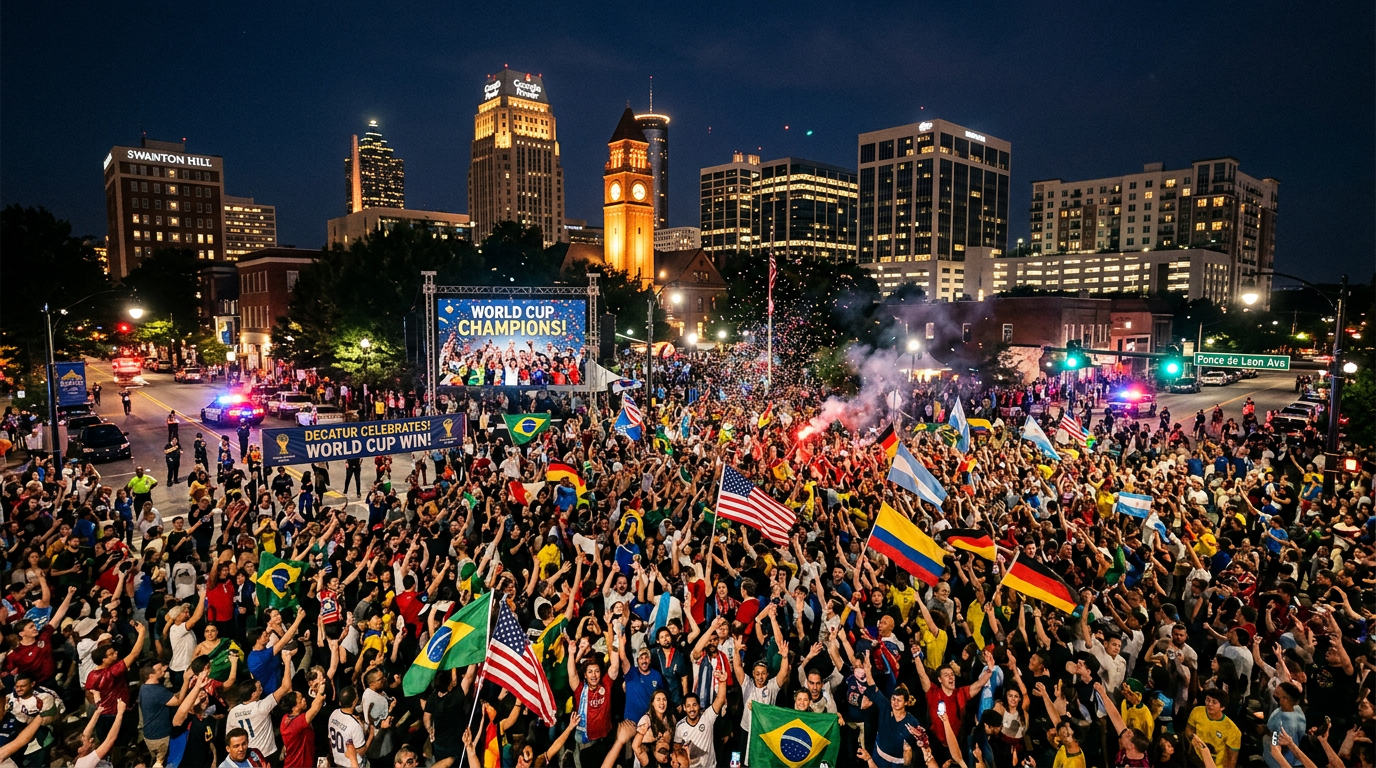
That is why Decatur WatchFest ’26 matters.
The city is planning a 34-day celebration around the World Cup, with free daily outdoor screenings, live music, games, restaurants, pubs, breweries, and indoor “WatchSpots” throughout the city. The event will run during the World Cup period from June 11 through July 19, 2026.
This is not just a soccer event.
It is an economic development strategy.
Big Boi is scheduled to kick off the festival with a free concert on Decatur Square on June 11, 2026, the first day of World Cup matches. The festival lineup also includes acts like The War and Treaty and Indigo Girls, with concerts taking place on Decatur’s newly renovated square.
That kind of programming gives people a reason to come early, stay longer, and spend money locally.
And that is where small businesses come in.
A restaurant in Decatur does not need to be inside Mercedes-Benz Stadium to benefit from the World Cup. A bar does not need an official FIFA logo to become a local watch party destination. A boutique does not need to sell soccer jerseys to create limited-edition Atlanta or Decatur merchandise. A coffee shop does not need to be downtown to become a morning stop for fans taking MARTA into the city.
The opportunity is there, but it will not automatically fall into every business owner’s lap.
Businesses have to prepare.
Menus need to be easy to read. Hours need to be updated. Google listings need to be correct. Websites need to load. Reservation systems need to work. Staff needs to be ready. Social media needs to make it clear what the business offers. Businesses should think through World Cup specials, watch party packages, group reservations, multilingual signage, local collaborations, and email list building.
The World Cup will bring attention.
The smart businesses will turn that attention into repeat customers.
Decatur also has a built-in advantage: access. The Decatur Square sits above the Decatur MARTA station, giving visitors a direct connection to downtown Atlanta without needing to drive. Event organizers are encouraging people to use MARTA or rideshare, while also noting Decatur has more than 10,000 parking spaces available daily.
That matters because ease of movement could shape where fans decide to spend their time.
If a visitor can watch a match, hear live music, grab food, walk the square, and take MARTA back toward Atlanta, Decatur becomes more than a suburb. It becomes part of the World Cup experience.
That is the bigger lesson.
Major events do not only benefit the host venue. They benefit the places that know how to package themselves around the moment.
Decatur is showing what that can look like.
Instead of waiting for fans to accidentally discover the city, Decatur is building a reason for them to come. Instead of letting Atlanta own the entire conversation, Decatur is positioning itself as a nearby cultural hub with its own identity.
That is how smaller cities win around major events.
They do not try to compete with the stadium. They create the afterparty, the watch party, the food stop, the family-friendly gathering place, the concert series, the local business corridor, and the memory people take home.
The 2026 World Cup will be a global event.
But for Decatur, the opportunity is local.
If the city and its businesses execute well, this could be more than a one-month economic spike. It could introduce thousands of new people to Decatur’s restaurants, shops, music scene, public square, and local culture.
Atlanta may host the matches.
But Decatur has a real chance to host the experience.
 Verified ATL